




































Can a handheld fiber laser really replace traditional welding or cleaning tools in industrial tasks?
In today's manufacturing and industrial landscape, precision, speed, and safety are non-negotiable. Many businesses have relied on traditional tools like arc welders, grinders, and chemical-based cleaning methods for decades. But now a new player has taken center stage — the handheld fiber laser. This tool, compact yet powerful, has transformed how industries approach metal cleaning, surface preparation, and even welding tasks.

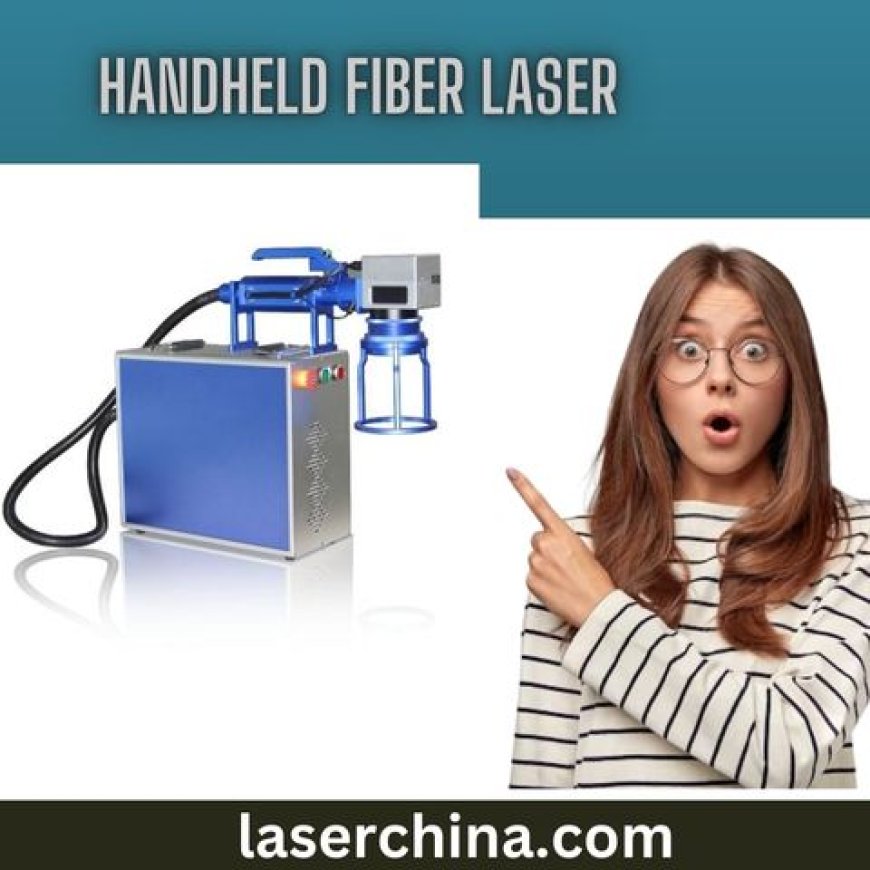
Lets dig into this transformation, grounded in real-world usage, industry data, and application-based insights.
What is a Handheld Fiber Laser?
A handheld fiber laser is a portable device that uses high-intensity laser beams delivered through fiber optic cables to perform precision operations like welding, rust removal, paint stripping, surface texturing, and more. It offers unmatched flexibility in handling various metals from stainless steel and aluminum to titanium and brass.
Unlike large stationary systems, a handheld fiber laser offers freedom of movement. You take the laser to the job, not the job to the laser. This is especially useful in large-scale industrial environments like shipyards, construction sites, and aerospace facilities where mobility matters.
Industrial Cleaning: The Laser Revolution
Lets talk about industrial cleaning. Traditionally, this involved:
-
Sandblasting, which can damage delicate surfaces and generate dust.
-
Chemical solvents, posing environmental and health risks.
-
Mechanical abrasion, which is slow and often imprecise.
The handheld fiber laser changes this. Instead of force or chemicals, it uses light energy to vaporize contaminants like rust, oil, paint, or oxides from surfaces. The process is called laser ablation. Its non-contact, highly targeted, and doesnt erode the base material.
Example Case:
In an automotive manufacturing plant in Turkey, maintenance teams switched to handheld fiber lasers for rust removal on engine parts. They cut down cleaning time by 70% and eliminated solvent usage entirely. More importantly, surface integrity was preserved no pitting, no warping.
Welding with Handheld Fiber Lasers
The same tool isnt just about cleaning its also changing how welding is done.
Fiber laser welding offers deep penetration, narrow seams, and minimal distortion. The handheld variant gives skilled workers the ability to weld with a precision usually only achievable with automated systems. Operators can perform spot welding, butt welding, and lap welding in tight spaces with a compact device that fits in the palm.
Real-World Application:
A shipbuilding company in South Korea began using handheld fiber lasers to weld thin aluminum panels on-site. Manual TIG welding used to take hours and left behind visible heat marks. The handheld fiber laser reduced processing time by over 60%, with cleaner seams and significantly reduced post-processing work.
Material Compatibility & Precision
From aerospace components to kitchen appliances, manufacturers use a variety of metals. A handheld fiber laser adapts effortlessly. It handles:
-
Stainless steel (common in food-grade equipment and architecture)
-
Aluminum (used in aerospace and automotive applications)
-
Copper and Brass (preferred in electrical components)
-
Titanium (critical in medical and military sectors)
Precision is where the handheld fiber laser really shines. Controlled by simple parameters (like frequency, pulse width, and power level), it can remove microns of material without touching the base layer. This is valuable in sensitive tasks like mold cleaning, semiconductor prep, and even art restoration.
Time-Saving & Operational Efficiency
Lets break down a practical scenario:
Imagine you're cleaning 100 rusted carbon steel parts. Using abrasive blasting, this might take up to 20 hours, plus clean-up time. Add the health and safety requirements, equipment prep, and youre easily investing a full workweek.
With a handheld fiber laser, the same job could be completed in 68 hours without masks, grit cleanup, or residue disposal. The laser tool heats up in seconds, is plug-and-play ready, and leaves nothing behind but clean metal. No downtime, no consumables.
Companies around the world are leveraging this efficiency to lower operating costs. Laser equipment is more expensive up front, yes, but the return on investment (ROI) is quick often within 612 months.
Operator Safety and Environment
Traditional tools come with noise, sparks, chemical fumes, and flying debris. In contrast, handheld fiber lasers operate with minimal noise and zero direct emissions. Most systems include fume extraction or can be used with mobile filtration units.
Laser operation requires safety goggles and basic training but the working conditions are cleaner, quieter, and safer. Operators aren't exposed to toxic media or sharp rotating tools. Maintenance is reduced as well, since there are no nozzles, wires, or abrasive parts wearing out.
Customization and Scalability
Handheld fiber laser systems are highly customizable. Manufacturers can select:
-
Power outputs (from 100W to over 2000W)
-
Beam types (CW or pulsed)
-
Scan heads (adjustable for pattern control)
-
Portable trolleys for mobility
-
Integrated cooling systems for continuous operation
As production needs grow, the same tool can be upgraded or replaced with a more powerful unit no need to overhaul the workflow. This scalability makes it ideal for small workshops and large factories alike.
Adoption Across Industries
Industries currently adopting handheld fiber laser technology at a rapid pace include:
-
Automotive for welding battery trays and rust removal
-
Aerospace for lightweight alloy cleaning and repair
-
Food Processing for sanitary surface prep
-
Energy Sector for cleaning turbine blades and pipeline surfaces
-
Defense & Military for restoration of aged components
In fact, global fiber laser market trends show a strong uptick in portable and handheld units. According to recent industry reports, demand for compact laser systems is projected to grow by over 12% annually through 2028, fueled by their versatility and low maintenance requirements.
Final Thoughts
The shift from traditional tools to handheld fiber laser isnt just about adopting a new technology. Its about redefining efficiency, safety, and surface control in demanding environments. Whether it's precision welding, contamination-free cleaning, or rapid surface prep, the handheld fiber laser has proven itself not as an alternative but as a new standard.
Its not the future anymore. Its the present, and those industries that have embraced it are already seeing the gains in productivity, quality, and operational simplicity.